
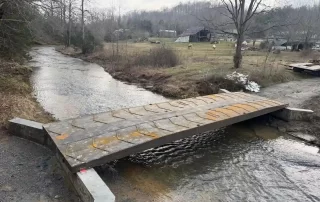
The Biggest Challenges and Dangers With Installing Temporary Bridges
Discover the Complexities of Temporary Bridge Installation
You have picked your site, ordered your bridge, and lined up a crew. Installation day feels close and simple: drop the panels, connect them, and drive across. But temporary bridge projects rarely fail because of the bridge itself.
The permit nobody applied for, the power line no one measured, and the frost no one expected at six in the morning are just a few of the hidden pitfalls that catch even experienced crews off guard. Learn more about the hurdles that can derail temporary bridge installation projects and what to do about each one before they become problems.
Receiving the Proper Permits
Most crews assume a single building permit covers the job. In practice, a temporary bridge can trigger several separate approvals at once, including demolition, environmental, and floodway permits, depending on what the bridge crosses and what it replaces.
The risk is not just delay. A government
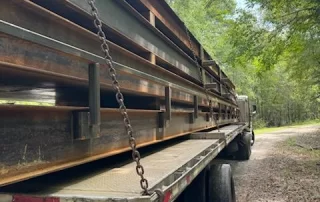
LIFTING AND TRANSPORT OF TEMPORARY PORTABLE BRIDGE PANELS
Most damage to temporary, modular bridge panels doesn’t happen while they’re in service, holding up a crane or a loaded dump truck exactly as they’re engineered to. It happens earlier, before a panel ever reaches the job site, during the lifting and transport phase that a lot of crews treat as routine logistics rather than something that needs its own procedure. A panel that gets rigged wrong, stacked wrong, or dragged instead of properly lifted can end up bent, twisted, or misaligned before installation day even starts. And a damaged panel discovered on site is a far bigger problem than a slower, more careful lift would have been. It can delay a project by days while a replacement is sourced, and depending on the damage, it may not be obvious until the crew is already trying to fit pieces together at the final location. Here’s how to handle

Understanding Load Ratings for Temporary Bridge Systems
Load ratings are one of the most common questions we get about temporary bridge systems, and for good reason. A crew that misjudges what can safely cross a bridge is taking on real risk, not just to the structure but to the people standing on and around it. The rating itself is only one part of the picture. How that rating is communicated, how it is enforced day to day, and how well a crew actually understands the weight of its own equipment all matter just as much as the number stamped on the bridge. Here is what every job site should know before equipment starts rolling across a temporary or portable bridge.
Post the Rating, and Enforce It
The load rating needs to be posted clearly at the job site where every operator can see it before they approach the bridge, not tucked away in

How to Reduce Corrosion on a Raw Steel Temporary Bridge
Three field-proven options, what they cost you in time and money, and where each one tends to fail.
Raw steel rusts. Everyone who has ever left a wrench out in the rain already knows that. The real question for anyone running a temporary bridge isn’t whether steel corrodes, it’s how you protect a structure that takes a beating no ordinary steel surface ever sees: tracked equipment grinding across it, road salt in the winter, constant flex and vibration under load, and months or years of exposure to weather with no shop roof overhead. We install and maintain modular bridges for a living, and we’ve watched every one of the options below hold up, and fail, in real field conditions. Here’s the honest rundown.
The Mistake We See Most Often on Job Sites
Before getting into what works, it’s worth covering what doesn’t. Somewhere along the way, someone on a

Protecting Your Temporary Bridge: Base vs. Abutment, and Why Loose Fill Matters
Base or Abutment? They’re Not the Same Thing
It’s a common question, and an important one to get right before any installation: what’s the difference between a bridge base and a bridge abutment?
The base is what the bridge itself physically sits on. For a temporary or portable bridge, that’s typically a combination of compacted gravel and timber crane mats. For a short-term installation, that base is often all you need.
The abutment is a different layer of protection entirely, and it becomes necessary in two situations:
- The temporary bridge will stay in place for an extended period, such as a full season.
- The bridge spans running water that is prone to flooding.
In either case, you need an abutment: loose stone fill or a poured concrete structure built around the base and extending
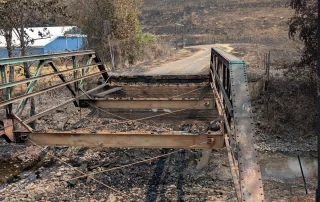
A BURNED BRIDGE: When Wildfire Takes a Bridge, What Replaces It?
A county road crew in a western state recently lost one of its older bridges to wildfire. The structure spanned 50 feet, carried two properties worth of daily traffic, and had served its community for decades. Then a fire moved through the area, and it was gone.
This is not an isolated story. Counties across the western U.S. are seeing more frequent, more intense fire seasons, and aging infrastructure is often caught in the path. When a bridge goes down, the question is rarely whether to rebuild. It is how fast a replacement can be rated, delivered, and installed before the next emergency arrives.
The Load Rating Problem Nobody Talks About
Here is the detail that often gets missed until it matters most: many older rural and county bridges were never rated for today’s firefighting equipment. Modern fire apparatus, fully loaded with water and gear,

WHAT IS AN AIR GAP BRIDGE?
When people hear “temporary bridge,” they usually picture one thing: a crossing over water, a ditch, or wet ground that equipment can’t drive through. That’s a fair assumption. It’s the most common use case. But there’s a second application that solves a very different problem, and it comes up more often than most contractors expect.
It goes by a few names, including air gap bridge, clear span temporary bridge, or utility protection bridge, and the job is the same in every case: create a gap between heavy equipment above and something fragile, valuable, or hazardous below. No contact. No load transfer. Just a clean span holding everything above ground level.
Why an air gap matters?
The term comes from exactly what it sounds like: an actual gap of air between the bridge structure and the surface underneath. Instead of resting equipment
WHAT SORT OF PERMITS MAY BE REQUIRED TO INSTALL TEMPORARY, PORTABLE, HEAVY DUTY VEHICULAR BRIDGES?
Building Permits for the delivery and installation of an industrial, temporary vehicular bridge can be the simplest thing or a giant headache. First thing to be aware of: do NOT just ask your neighbor what they did to install their equipment bridge 10 years ago. Building and civil engineering regulations change, and what was allowed then with a simple one-page permit may now be woefully inadequate for modern heavy construction standards.
Do not be tempted to just skip the whole process and think, “No one will notice if I’m installing a temporary construction bridge up in the back woods somewhere for a 1-month project.” I know this from personal experience. We had a project—it was a simple property upgrade—and the local inspector stopped by, looked me in the eye, and said, “You knew better than this.” We had to halt the industrial project site, engage an architect, and prepare
INDUSTRIAL TEMPORARY BRIDGES INSTALLATION – a checklist…
EQUIPMENT NEEDED
- Crane or boomlift: Remember it must be able to comfortably reach the center of the temporary bridge span while NOT sitting at the very edge of the ravine or creek. A crane + an industrial modular bridge = a very heavy load. You don’t want your equipment sliding down an embankment.
- A level or transit and string lines: To check for a smooth base.
- Proper PPE: Hard hat, steel-toe boots, leather gloves.
- Proper lifting equipment: Lifting chains, heavy-duty slings with clevis hooks, etc. Double-check the load ratings on all equipment before installing your portable bridge.
- A crew: At least 5–6 people, and more depending on the structural size of the project.
DELIVERY OF YOUR PORTABLE BRIDGE
- It sounds simple, but don’t forget to have a clear staging area for your portable bridges when they arrive on site. That flatbed truck isn’t going to sit there all day waiting for
SITE WORK: PREP BEFORE INSTALLATION OF TEMPORARY, PORTABLE, AND PRE FAB BRIDGES
Are you getting ready to install a bridge on your project site? Proper site preparation is the key to a safe and successful setup. Whether you are using temporary bridges for short-term access or setting up modular systems, here is everything you need to know before delivery day.
Regulatory and Ground Prep
- Check local regulations: Be sure to check for any building permits or local municipal inspections that may be needed. Don’t rely on what you hear from your neighbor or even a local contractor. Call your building department directly.
- Avoid soft terrain: No temporary bridges should ever be installed directly on soft, wet ground—such as wetlands, marshes, or visibly wet, soft soil. The structure will immediately sink when heavy loads are driven across.
- Ensure solid ground clearance: Temporary bridges should be installed on at LEAST 5 feet of solid ground on either side of an open span—and 6 to 8
Get a Quote
Reliable access can make or break a construction timeline. Spanweld Bridges delivers durable solutions designed to keep your crews working and your project on track. Share a few details about your site, timeline, and load requirements, and our team will recommend the right bridge system for your application.
